Civil engineering · seismic resilience · research
Mantu
Shrivastav
Research Associate | Civil Engineer | Structural Engineering Enthusiast
I work at the intersection of earthquake engineering, structural analysis, seismic vulnerability assessment and data-driven civil engineering, with a growing focus on reinforced-concrete and traditional masonry structures.

Currently
Research Associate at IHRR, Kathmandu
About
Engineering structures for a more resilient future.
I am a civil engineer specializing in earthquake engineering and structural analysis. My research interests include structural dynamics, seismic risk assessment, seismic performance of RC and masonry buildings, computational modelling and machine-learning applications in civil engineering.
At the Institute of Himalayan Risk Reduction, I contribute to “Seismic Synergy: Learning From Traditional Wisdom To Bring A Resilient Future” , supporting seismic vulnerability assessment and heritage conservation of traditional Newari masonry buildings in the Kathmandu Valley.
Research interests
Focused on structures, earthquakes and computational tools.
Earthquake Engineering
Seismic response, structural dynamics, code comparison and vulnerability assessment of buildings.
RC & Masonry Structures
Performance evaluation of reinforced-concrete systems and traditional load-bearing masonry buildings.
Computational Engineering
Python-based structural tools, parametric analysis, finite-element modelling and design automation.
Machine Learning
Prediction of concrete strength, soil liquefaction potential and engineering performance indicators.
Experience & leadership
Research, technical leadership and education.
2026 — Present
Institute of Himalayan Risk Reduction
Research Associate
Working on Seismic Synergy with a focus on seismic vulnerability assessment, structural modelling, heritage conservation and comparative analysis of traditional building typologies with an Indonesian partner team.
2026
Yathartha — National-Level Shake Table Competition
Event Organizer & Technical Mentor
Coordinated competition activities and mentored a seismic-resistant model team working on eddy-current damping principles.
2024 — 2025
TLCD Physical Model Project
Group Leader
Led the design, fabrication and testing of a Tuned Liquid Column Damper model for seismic vibration control.
2021 & 2024
Secondary Schools, Nepal
Mathematics Teacher
Taught mathematics to students from Grades 5–10, emphasizing conceptual understanding, examination preparation and problem-solving.
Selected publications
Research in seismic analysis and structural engineering.
Evaluating the Accuracy of Equivalent Static vs. Response Spectrum Method for Seismic Analysis of Buildings of Varying Heights
R. Shrestha, M. Shrivastav, and R. Pal · International Journal on Engineering Technology
Open DOI ↗Comparative Seismic Performance Evaluation of RC Dual System Buildings Under NBC 105:2025 and IS 1893 (Part I):2025 Across Varying Heights
M. Shrivastav, R. Shrestha and R. Pal · Journal of Innovations in Engineering Education, 9(1), 16–26
Open DOI ↗Comparative Seismic Performance Evaluation of RC Dual System Buildings Under NBC 105:2020 and IS 1893:2016 Across Varying Heights
R. Pal, R. Shrestha and M. Shrivastav · International Journal on Engineering Technology, 3(2), 217–228
Open DOI ↗A Python-Based Parametric Investigation of Concrete Grade Effects on Axial-Flexural Interaction Capacity of RC Columns
M. Shrivastav, R. Shrestha, R. Pal, P. Budhathoki and R. K.C. · InJET-InDev
Under reviewFire Assessment in RCC Structures: Safeguarding Nepal’s Built Environment
M. Shrivastav and R. Shrestha · Civil Transcend, Issue IV
Read in Civil Transcend ↗Understanding the Panama Canal Functionality and Global Impact
M. Shrivastav, R. Shrestha, R. Chaulagain and M. Marasini · Civil Transcend, Issue IV
Read in Civil Transcend ↗Selected projects
From seismic modelling to engineering software.
Eight-Storey High-Rise RCC Building
Modelled and analysed an eight-storey building in ETABS under gravity and seismic loading, followed by structural member design using NBC and IS provisions.
ETABS
Seismic analysis
RCC design
Tuned Liquid Column Damper
Designed and fabricated an award-winning physical TLCD model demonstrating structural vibration reduction under simulated seismic loading.
Structural dynamics
Physical model
RCC Member Design Tool
Developed a Python-based automated design tool for beams, columns and slabs, including capacity checks, reinforcement details and calculation sheets.
Python
NBC
IS codes
Featured Live Engineering Tool
P–M Interaction Curve Generator
Generate axial force–moment interaction curves for rectangular, T-shaped, L-shaped and circular reinforced-concrete columns directly in your browser.
Multiple column shapes
Interactive calculations
Engineering visualization
HTML
JavaScript
IS 456:2000
Launch Live Demo
Concrete Strength Prediction
Compared regression models for predicting concrete compressive strength from mix-design parameters and constituent proportions.
Machine learning
Data analysis
Soil Liquefaction Potential
Trained classification models using geotechnical data to support liquefaction susceptibility assessment under seismic conditions.
Geotechnical
Classification
Recognition
Awards for research, models and technical innovation.
Best Final Year Project Award
Thapathali Graduate Conference, IOE
View certificate
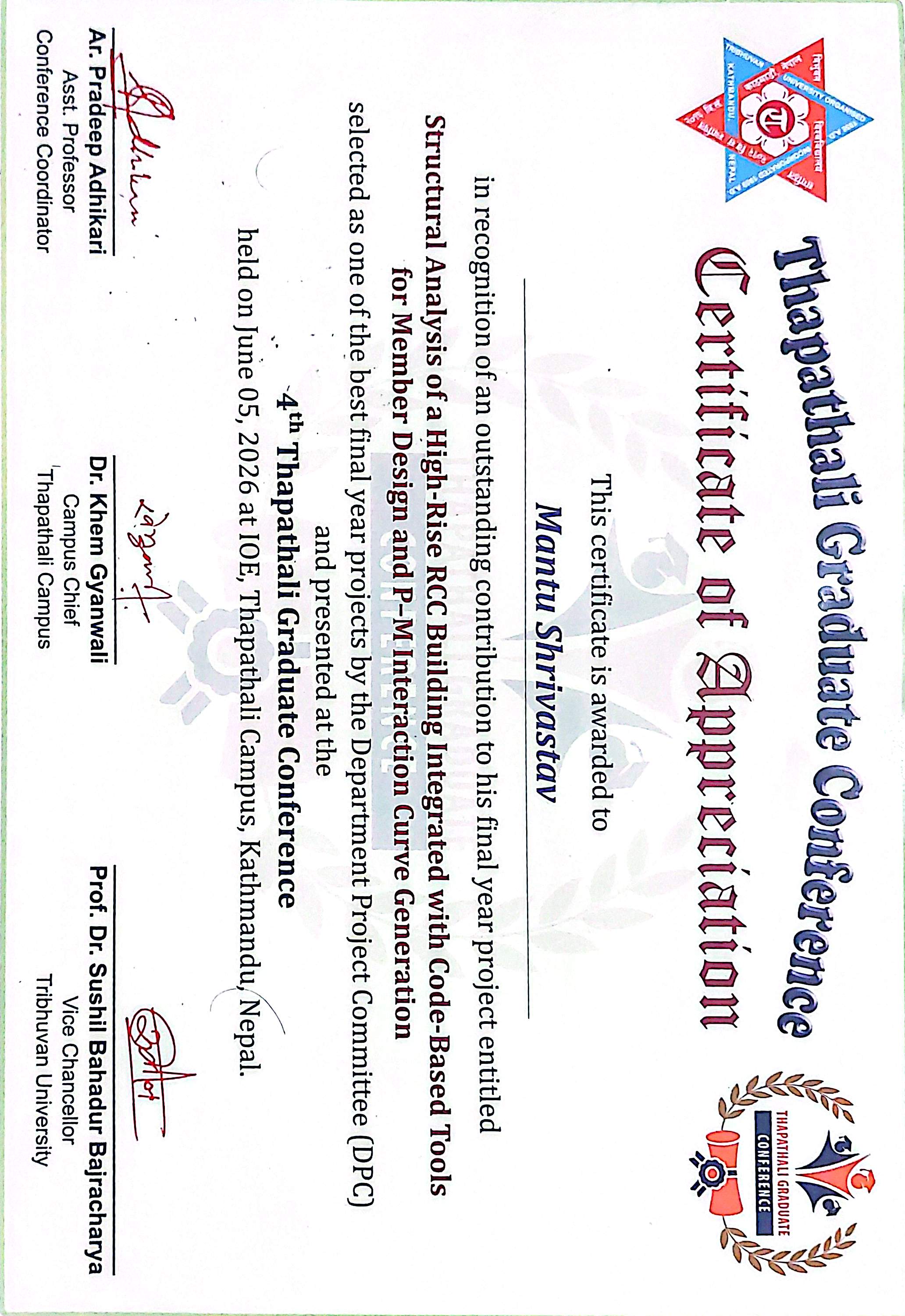
1st Place — Earthquake Resistant Building Model
Nepal Engineers Association
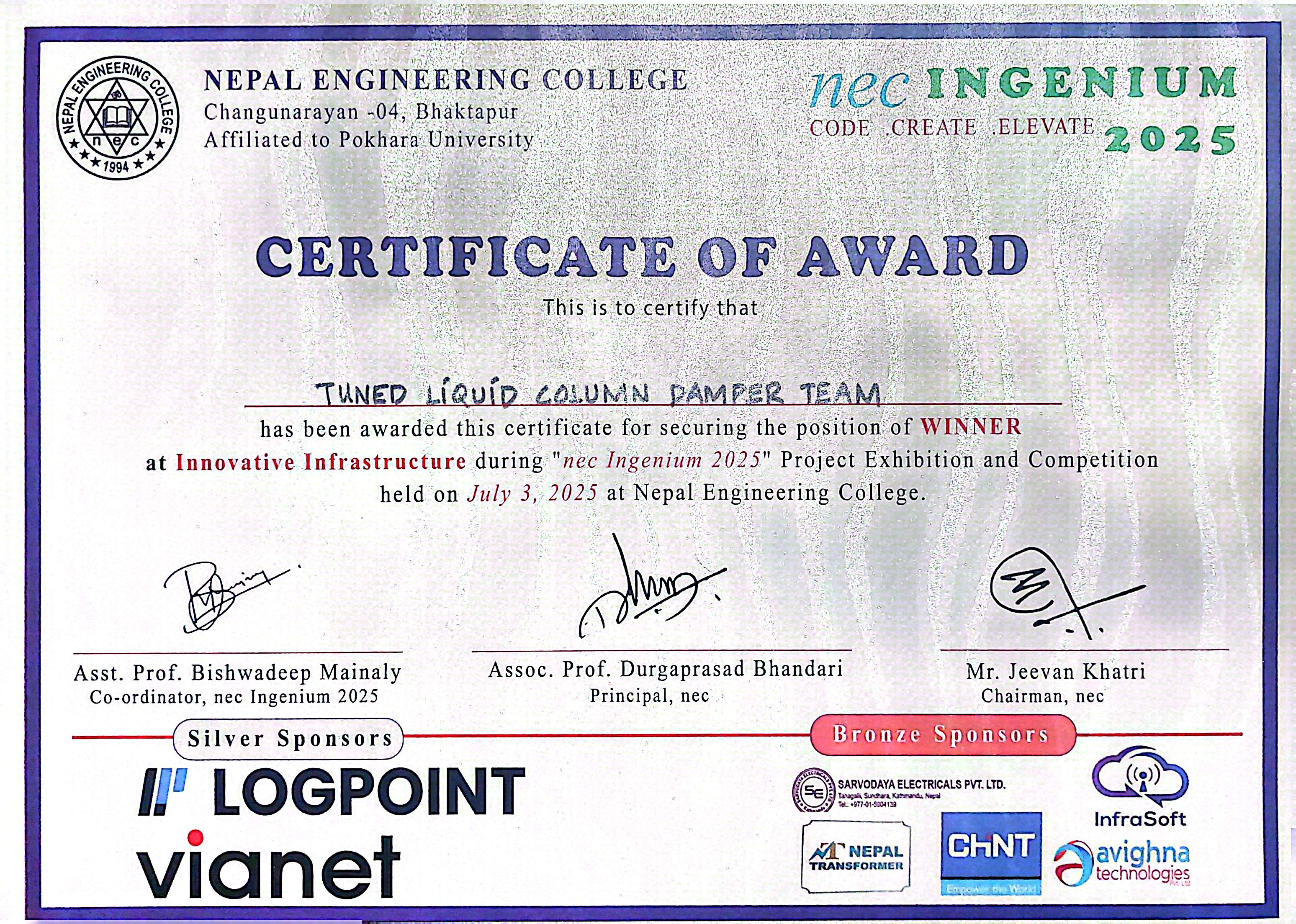
1st Place — National-Level Model Competition
NEC Ingenium 2025 · Tuned Liquid Column Damper
View certificate
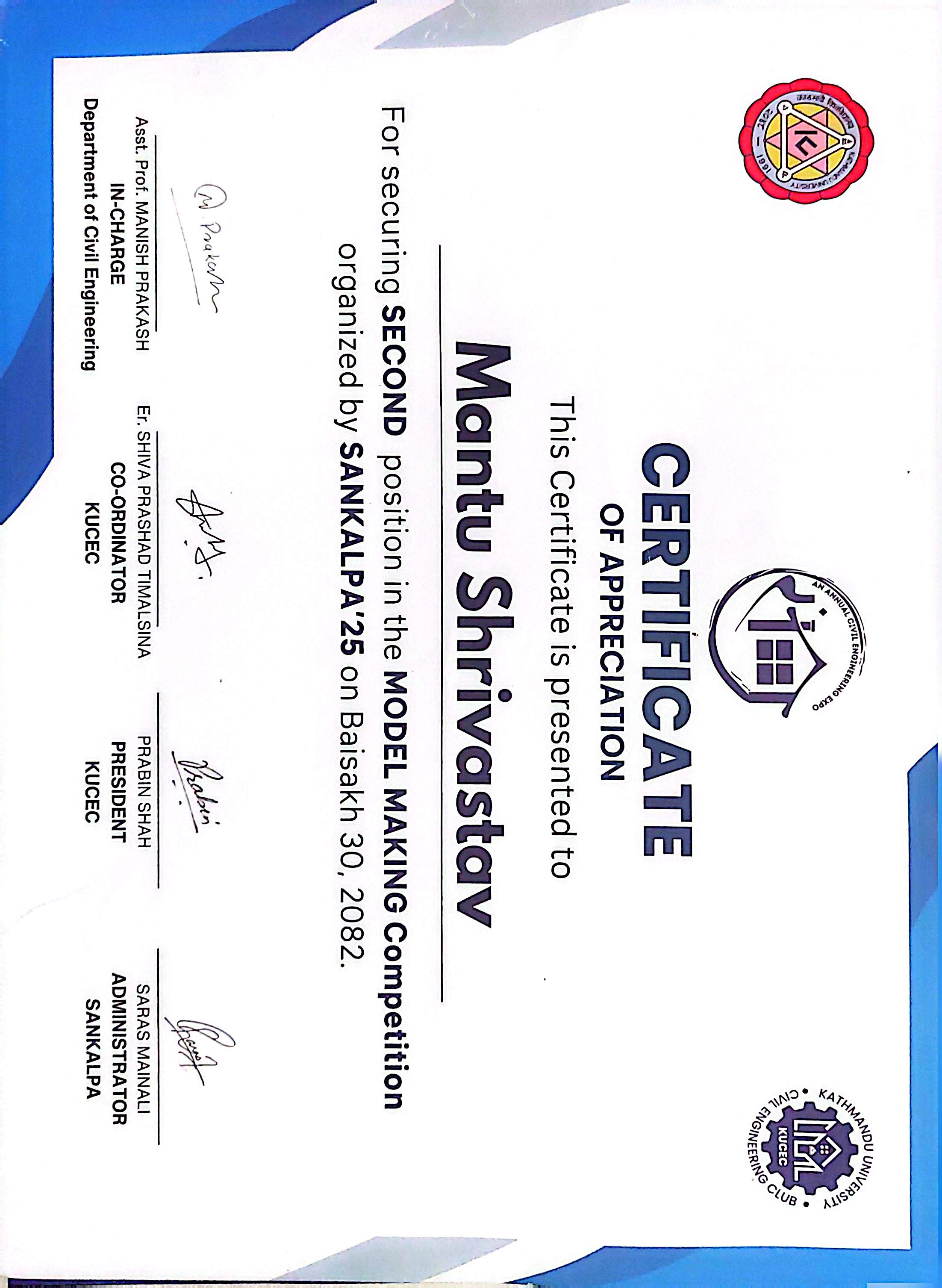
2nd Place — Sankalpa Model Competition
Kathmandu University
View certificate
Public Choice Winner
Panama Canal Physical Model · Thapathali Campus
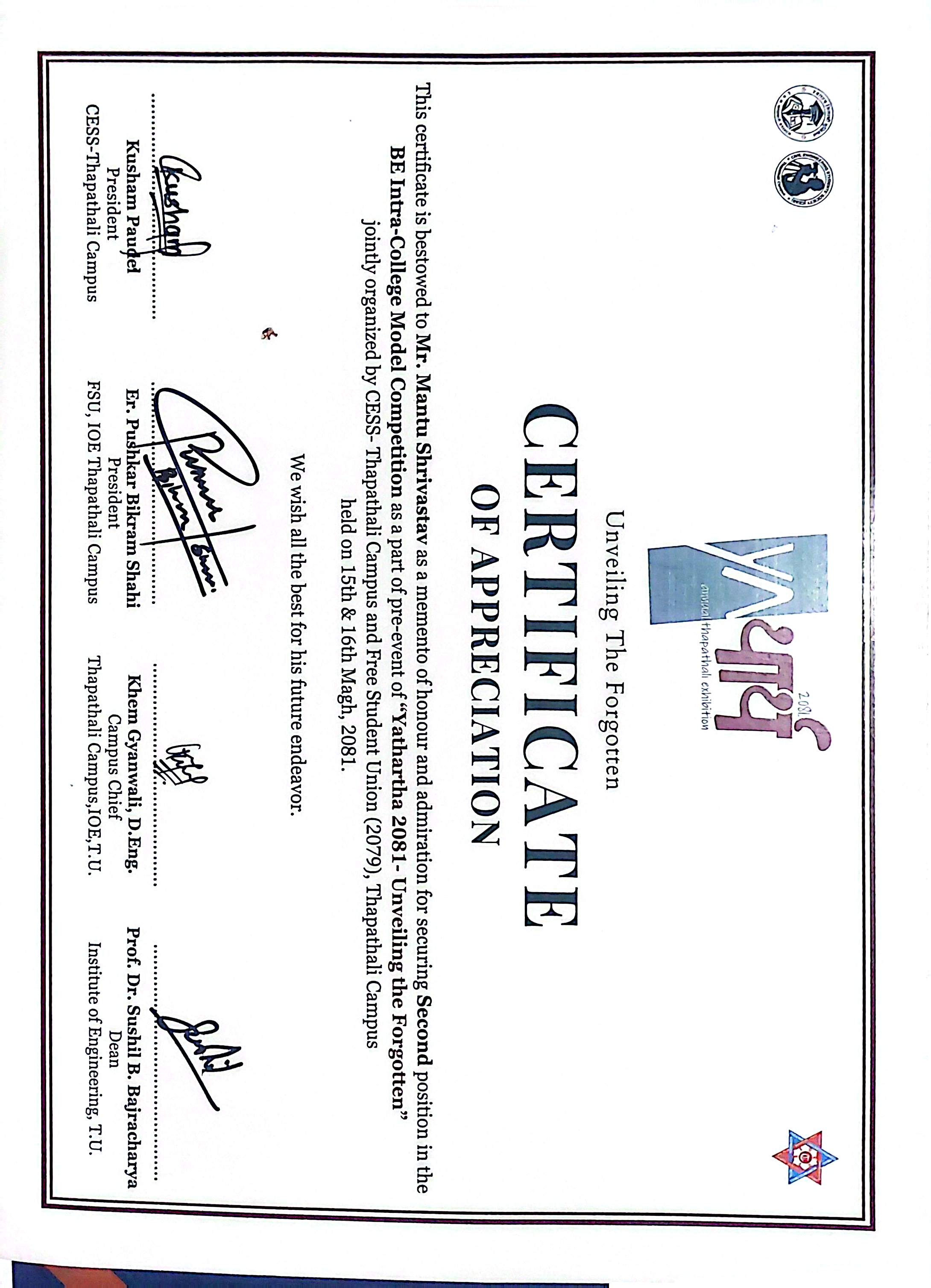
2nd Place — Intra-College Model Competition
Yathartha 2081 · Thapathali Campus · TLCD
View certificate
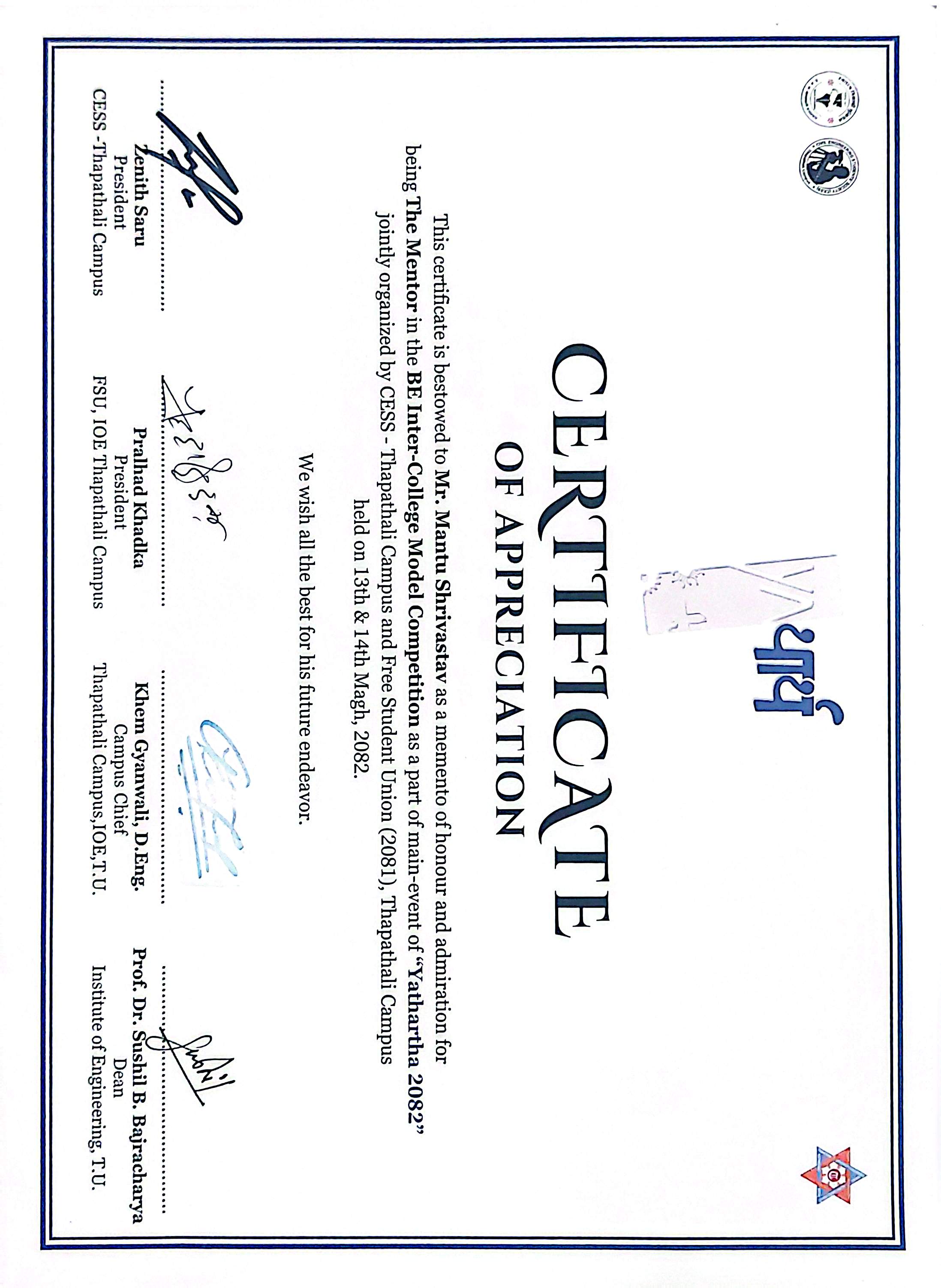
2nd Place — All Nepal Civil Model Competition
Yathartha 2082 · Eddy Current Damping · Technical Mentor
View mentor certificate
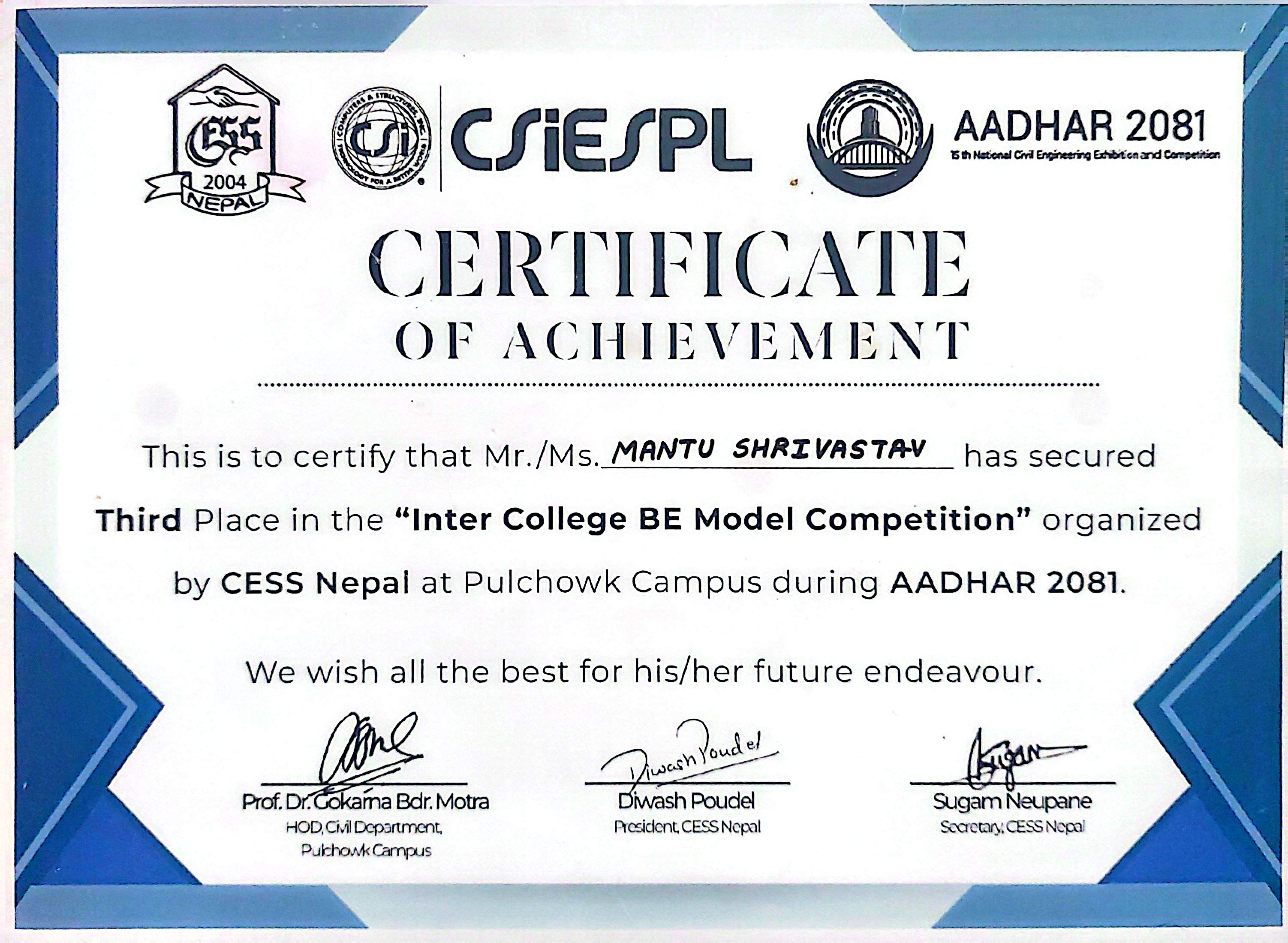
Most Innovative Model Prize
Adhar · Pulchowk Campus · Eddy Current Damping · Technical Mentor
Technical toolkit
Software, programming and analysis skills.
Structural
ETABS · SAP2000 · SAFE · DIANA FEA
Programming
Python · MATLAB · C · C++ · VBA · LaTeX
CAD & design
AutoCAD · Technical drawing
Data & office
Excel · SmartPLS · Word · PowerPoint
Certificates
Training, research, publication and professional participation.
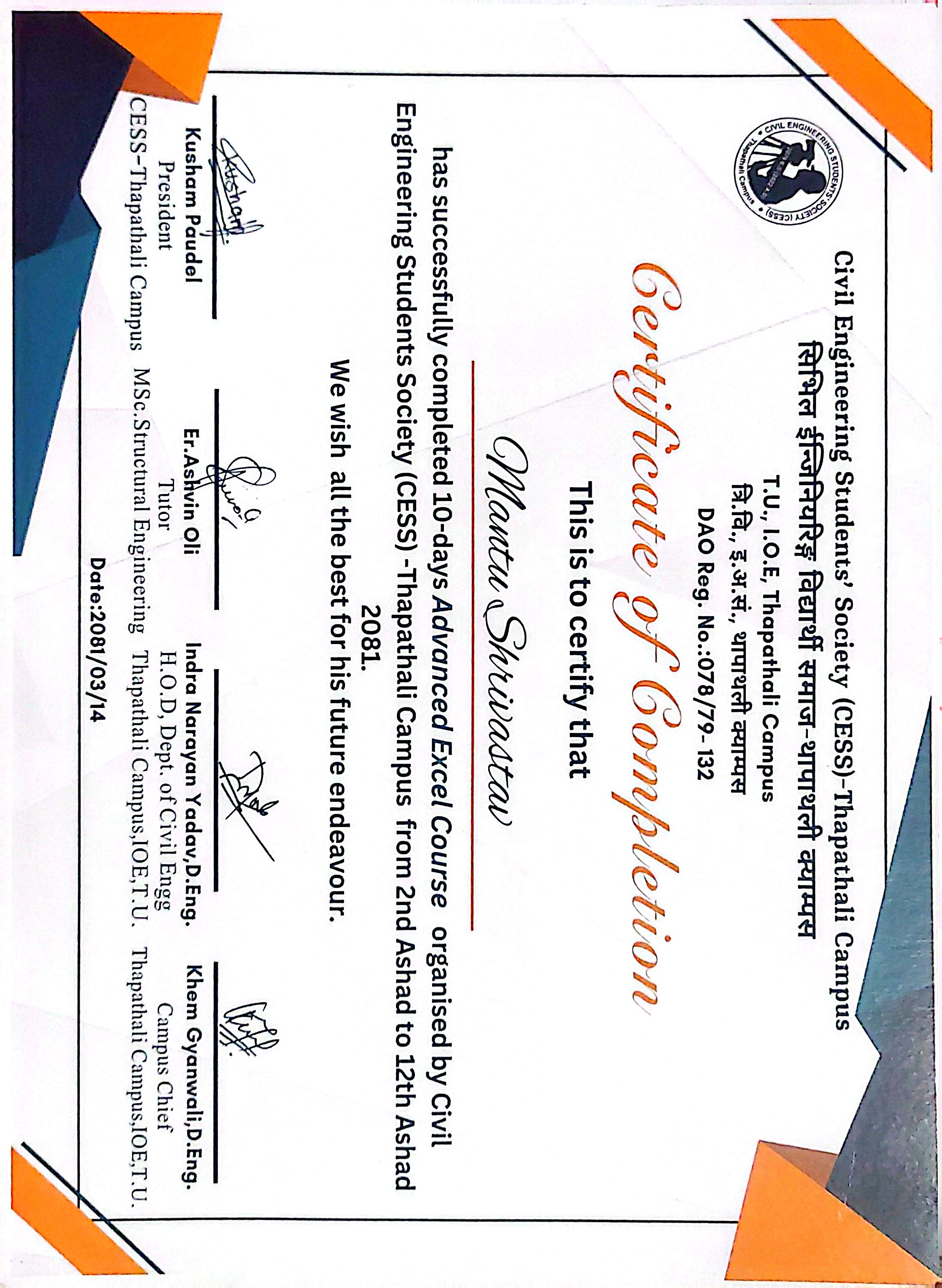
Advanced Excel Course
Civil Engineering Students’ Society, Thapathali Campus
View certificate
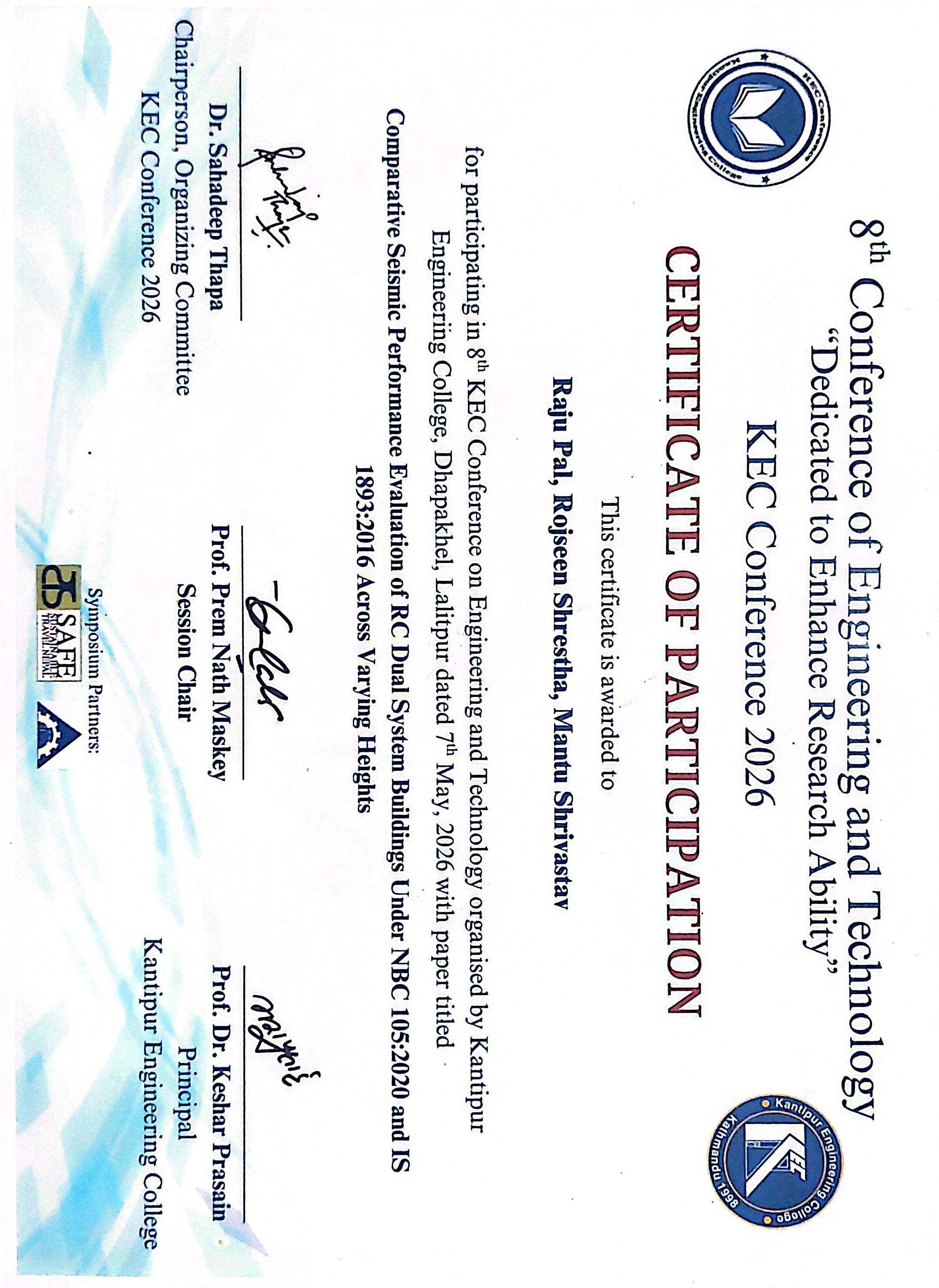
KEC Conference 2026
Paper presentation on comparative seismic performance evaluation of RC dual-system buildings.
View certificate
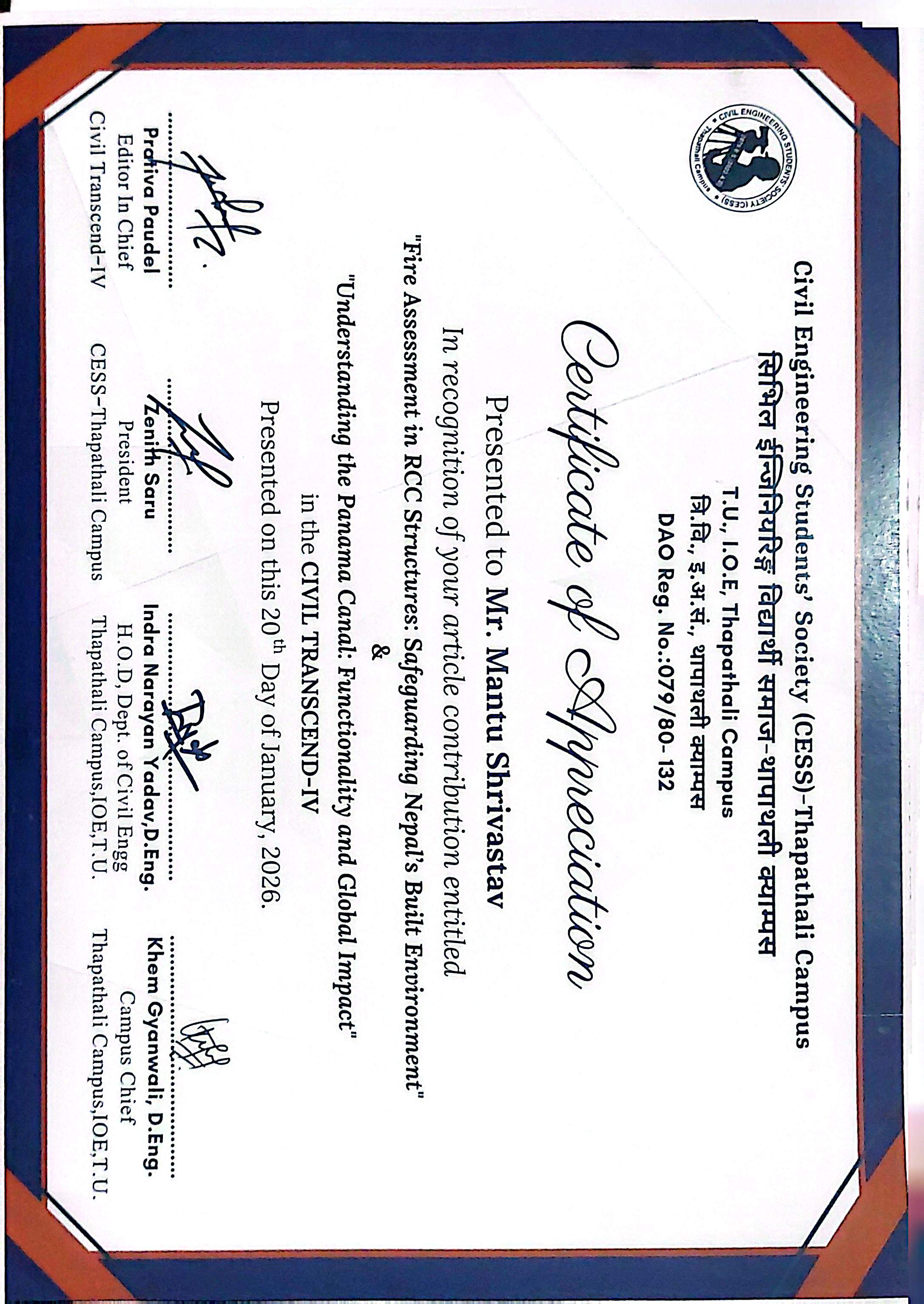
Civil Transcend Article Appreciation
Fire Assessment in RCC Structures: Safeguarding Nepal’s Built Environment.
View certificate
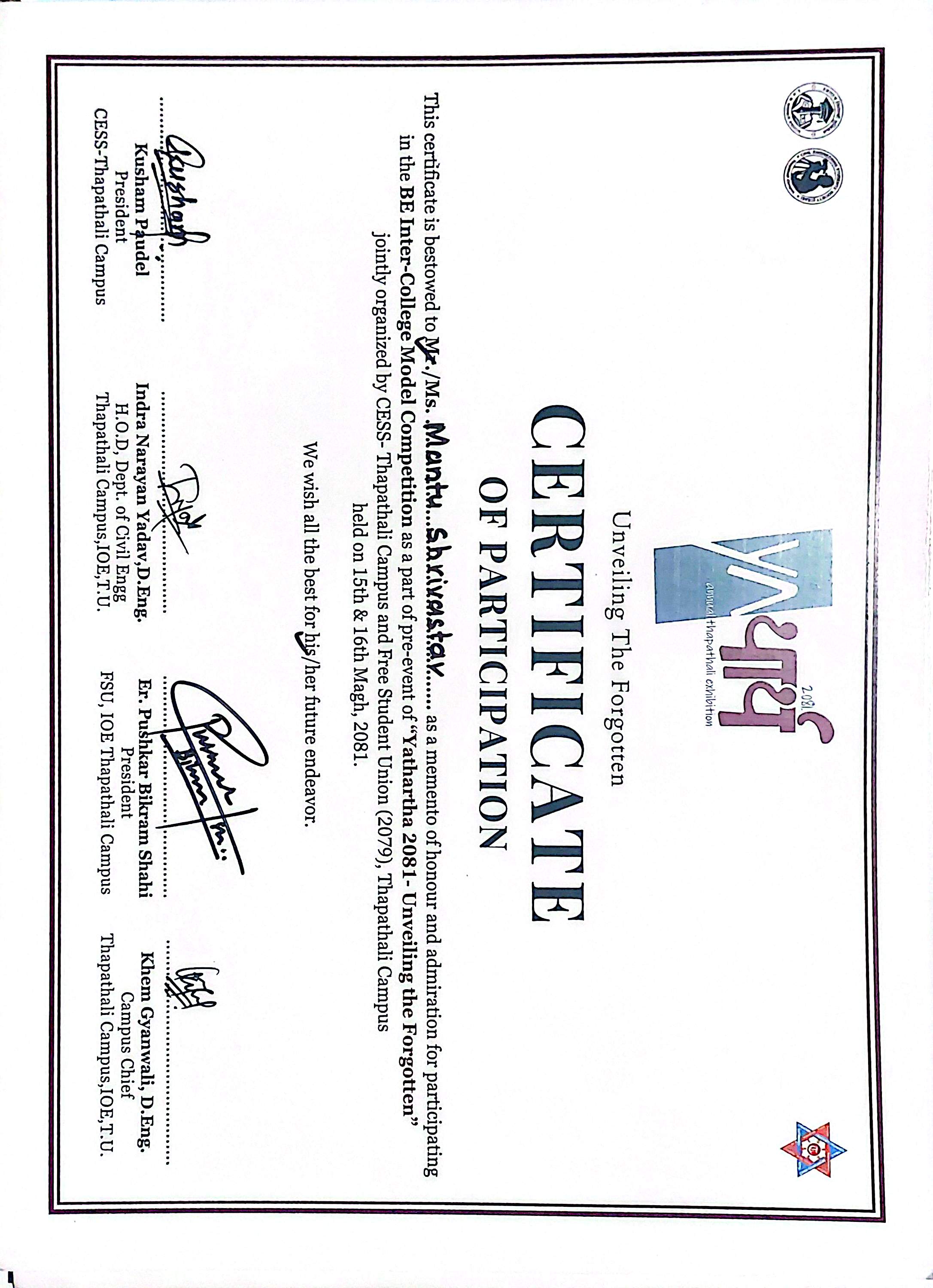
Yathartha 2081 Model Competition
BE Inter-College Model Competition, Thapathali Campus
View certificate
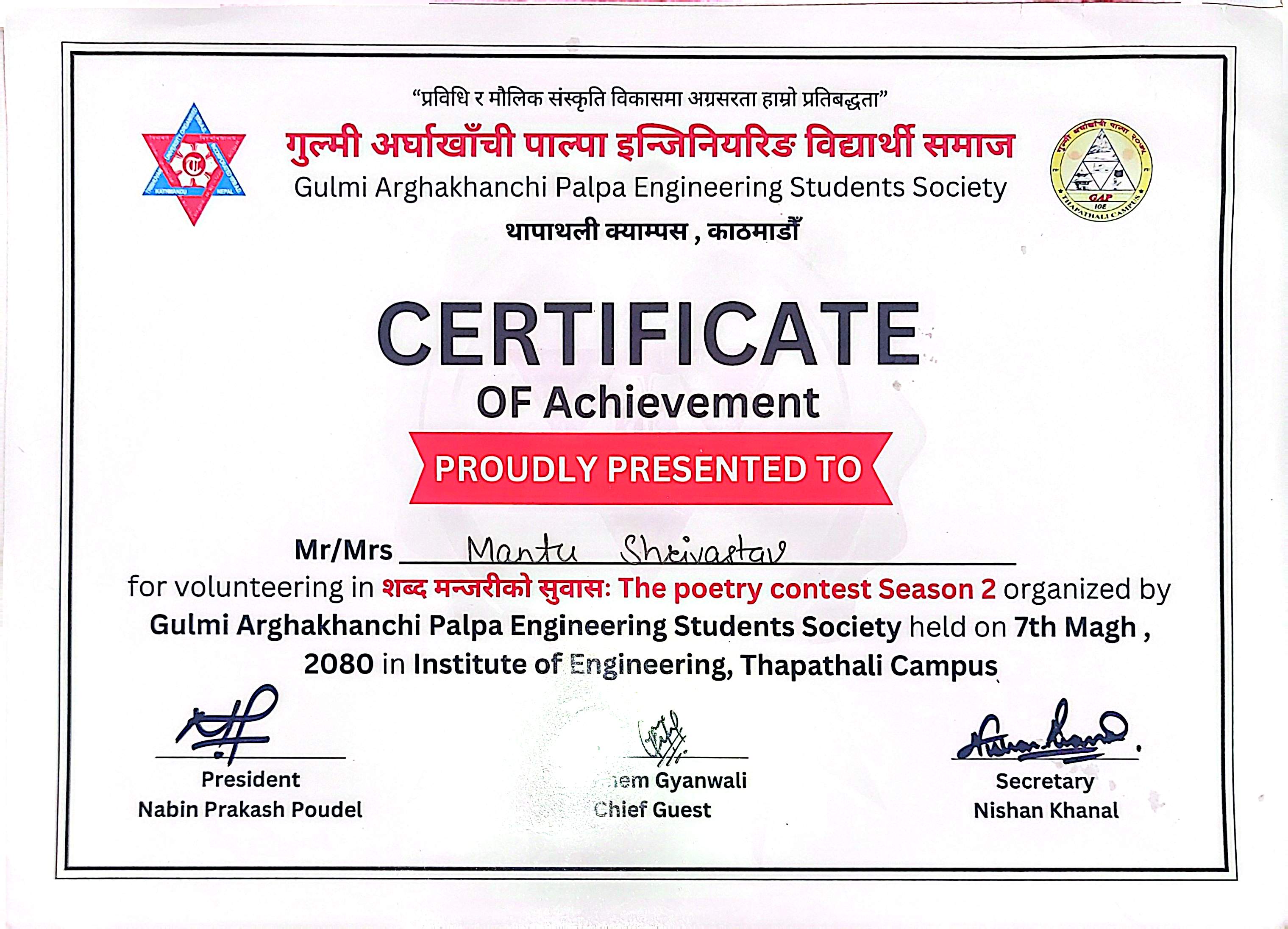
Poetry Contest Volunteer
Gulmi Arghakhanchi Palpa Engineering Students Society, Thapathali Campus.
View certificate
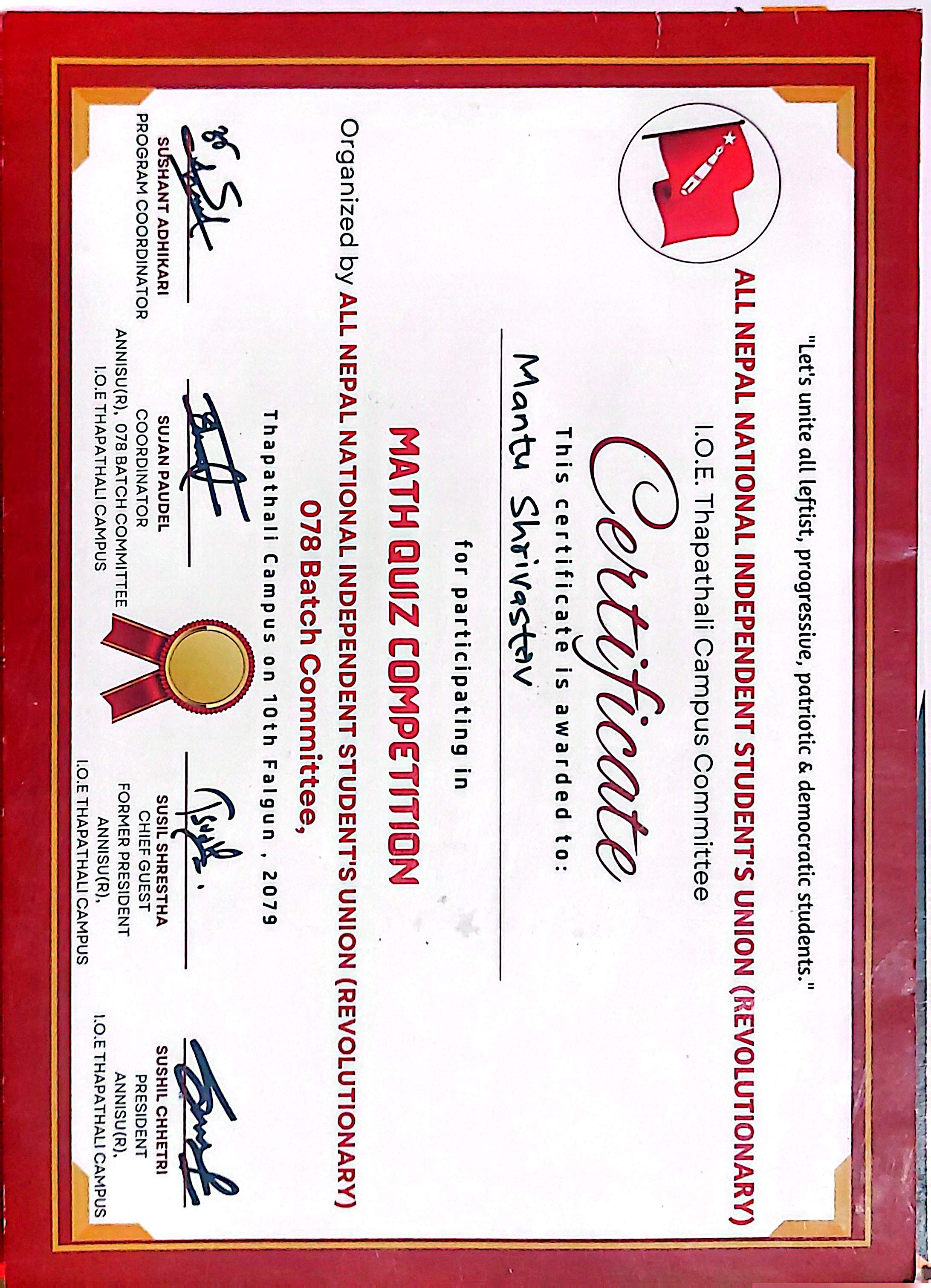
Mathematics Quiz Competition
All Nepal National Independent Students’ Union, Thapathali Campus.
View certificate
Education
Academic foundation in civil engineering.
2022–2026
Bachelor of Engineering in Civil Engineering
Institute of Engineering, Thapathali Campus · Tribhuvan University · Kathmandu, Nepal
Let’s connect